Learning outcomes are specific descriptions of the most important skills students will gain by taking your course.
Learning objectives are specific descriptions of what students will engage with on a week to week or module to module time frame. Think of objectives as the incremental learning goals that lead to the broader course outcomes.
When writing course and lesson learning outcomes and objectives:
- Begin your list of outcomes with the phrase, “After successfully completing this [lesson/course], you will be able to: ____”
- Write outcomes and objectives using the following list of measurable action verbs based on Bloom’s Taxonomy
- Create meaningful and measurable objectives:
- A “meaningful” objective describes exactly what a learner will be able to do, know, or feel at the end of a lesson (Use action verbs from Bloom’s Taxonomy to write each outcome.)
- A “measurable” objective means you can assess whether the students successfully mastered the content in your class. (Use action verbs from Bloom’s Taxonomy to write each objective.)
- List learning outcomes on your course syllabus, and list objectives on weekly overview pages.
Related Resources
- Developing measurable learning outcomes, from Teaching@UW
- Alignment – teaching strategies, assessment and learning outcomes, from Carnegie Mellon
- Writing Learning Objectives: Measurable and Mighty, from NC State
Bloom’s Taxonomy: Action Verbs
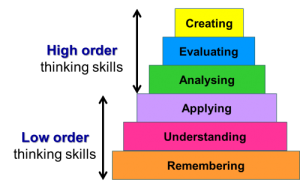
A group of educators led by Benjamin Bloom, identified a hierarchy of six categories of cognitive skills: knowledge, comprehension, application, analysis, synthesis and evaluation. As students learn, they start with the knowledge level and progress through the hierarchy. Thus, advanced courses should include skills at a higher level than introductory or basic skills courses. Below you will find a list of measurable verbs to assist you in writing course objectives and assess learning outcomes.
Hierarchy of Thinking Skills
List of Measurable Action Verbs
| list | record | underline |
| state | define | arrange |
| name | relate | describe |
| tell | recall | memorize |
| recall | repeat | recognize |
| label | select | reproduce |
Comprehension Level
The successful student will restate or interpret information in their own words.
| explain | describe | report |
| translate | express | summarize |
| identify | classify | discuss |
| restate | locate | compare |
| discuss | review | illustrate |
| tell | critique | estimate |
| reference | interpret | reiterate |
Application Level
The successful student will use or apply the learned information.
| apply | sketch | perform |
| use | solve | respond |
| practice | construct | role-play |
| demonstrate | conduct | execute |
| complete | dramatize | employ |
Analysis Level
The successful student will examine the learned information critically.
| analyze | inspect | test |
| distinguish | categorize | critique |
| differentiate | catalogue | diagnose |
| appraise | quantify | extrapolate |
| calculate | measure | theorize |
| experiment | relate | debate |
Synthesis Level
The successful student will create new models using the learned information.
| develop | revise | compose |
| plan | formulate | collect |
| build | propose | construct |
| create | establish | prepare |
| design | integrate | devise |
| organize | modify | manage |
Verbs to Avoid Bloom’s Taxonomy Revisited with AI
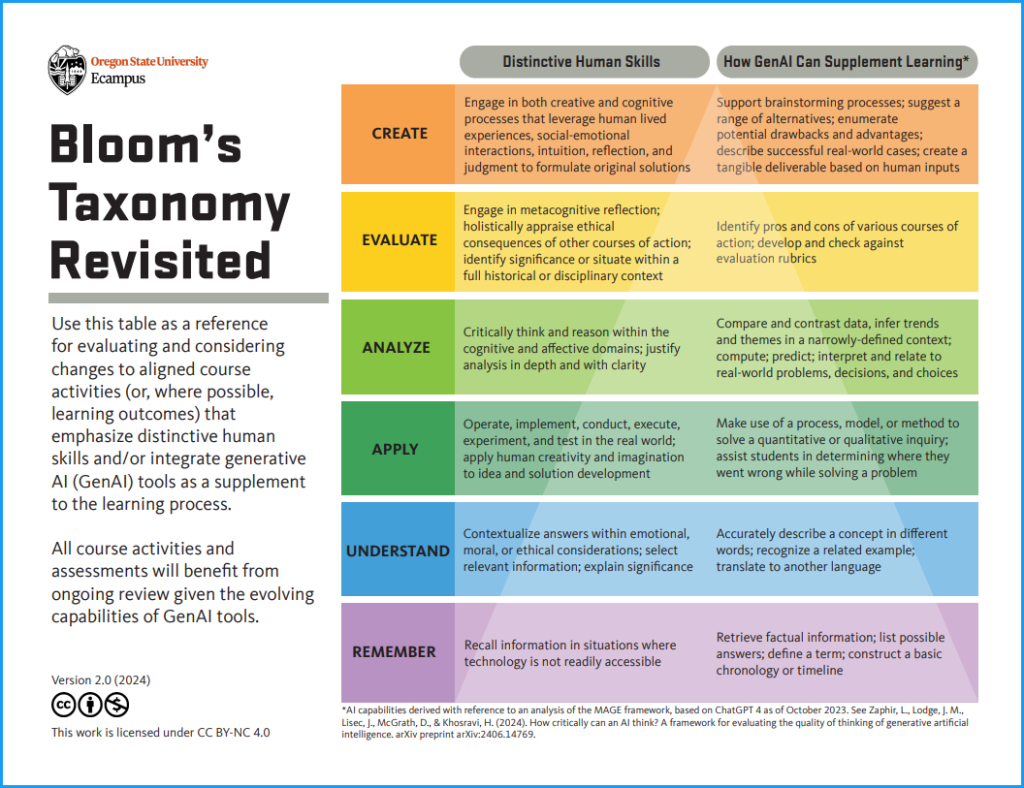
Bloom’s Taxonomy Revisited — with AI
- Oregon State University reconsidered course outcomes and student learning in the age of artificial intelligence, asking: What changes may be needed to ensure thoughtful integration of AI into course design, and student use, to promote meaningful?
Consider this Bloom’s Taxonomy Revisited:
Updated 05/29/2026